
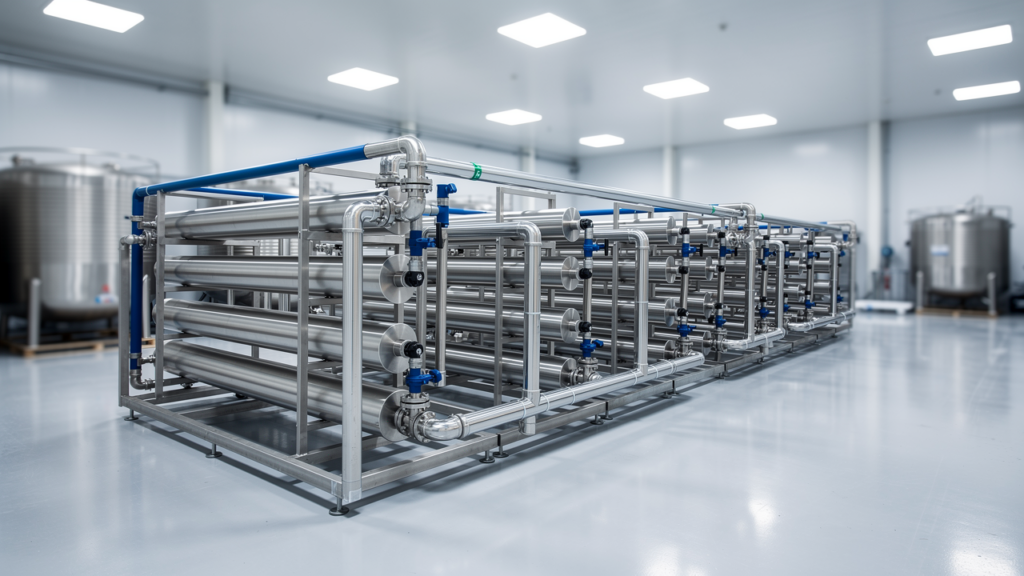
Choosing the Best Commercial Reverse Osmosis System for Your Business is rarely a matter of picking the unit with the highest number on its spec sheet. Facilities that get this right start by weighing feed water quality, total volumetric demand, peak flow rates, and how much maintenance a site can realistically sustain week to week.
Selecting commercial reverse osmosis systems involves far more than nominal capacity. Two buildings using the same amount of water daily can end up needing completely different pretreatment trains, storage arrangements, and control panels once their source water chemistry gets compared side by side.
Well-run installations are sized against worst-case conditions, a cold snap in January, a spike in dissolved solids after a municipal supply change, rather than the comfortable seasonal average. That design choice separates systems running reliably for a decade from ones that struggle within two years.
Choosing the Best Commercial Reverse Osmosis System for Your Business
Most commercial enterprises run through a similar checklist before signing off on hardware. A raw water sample gets tested for total dissolved solids (TDS), silica, hardness, iron, and residual chlorine or chloramines, since each of these dictates a different piece of equipment upstream of the membranes. The EPA overview of water treatment technologies lays out baseline filtration mechanisms and regulatory context most municipal supplies already meet, which helps facilities see what's already handled before water reaches the property line.
Three pillars tend to drive the final decision: purity targets measured in conductivity or TDS, volume requirements split between average and instantaneous peak flow, and total cost of ownership weighed against upfront capital spend. Local conditions matter too, drainage capacity for the reject stream and the footprint available inside a mechanical room can rule out an otherwise good system on paper.
Evaluating Feed Water Chemistry and Quality Targets
A certified laboratory water analysis, not a hardware-store test strip, is what most engineers require before quoting hardware. Free chlorine and chloramines destroy thin-film polyamide membranes outright, while iron, manganese, and turbidity cause physical plugging that cleaning rarely reverses fully. Hardness pushes membranes toward scaling well before their rated lifespan.
Quality targets shift by industry. Boiler feed water needs conductivity near zero, spot-free vehicle rinsing tolerates a modest TDS window, and beverage production sits in between with flavor-sensitive mineral limits. Once the target conductivity is set, that number decides whether a standard single-stage configuration is enough or whether a polishing stage needs to be added downstream.
Sizing a System: From Daily Volume to Peak-Hour Demand
Facilities usually start sizing in liters per day (LPD), then convert to liters per hour (LPH) once operating hours are known. A car wash running ten hours a day needs a different LPH rating than a 24-hour bottling line consuming the same daily total. Average daily demand and instantaneous peak demand are separate figures, a site running simultaneous sanitation cycles and production lines can see peak draw several times its average, and undersizing for that spike is a common design failure. The DuPont FilmTec technical manual explains the correction factors engineers use to translate nominal membrane ratings into realistic output under real site conditions.
Peak Flow, Storage Buffers, and Correction Factors
Relying on direct-flow RO production alone during a rush period usually creates a bottleneck, since membranes perform best with steady feed pressure and flow. Pairing a moderately sized RO skid with a storage tank and a re-pressurization pump lets membranes run at a stable rate while the tank absorbs demand spikes, often at lower capital cost than oversizing the skid itself.
Nameplate figures, a typical 38,000 LPD (10,000 GPD) rating, for instance, are measured at a standard test temperature of 25°C and a set feed pressure. Water at 5°C can yield roughly 40 to 50 percent less permeate than the same membrane at 25°C, so engineers apply a temperature correction factor rather than trusting the nominal number directly. Running a system continuously at full duty cycle also accelerates wear, which is why a 20 to 30 percent operational buffer is standard practice.
Pretreatment: The Step Facilities Skip and Regret
Pre-filtration exists because high-pressure membranes are expensive, and anything shortening their life multiplies operating cost. Thin-film composite polyamide membranes, standard in commercial reverse osmosis systems, are permanently oxidized by chlorine and chloramines on contact, while suspended solids physically plug feed channels and force early replacement. Depth cartridge prefilters rated at 5 microns and then 1 micron catch sand, rust, and colloidal matter, and rising differential pressure across those housings signals when a cartridge needs swapping. Granular activated carbon beds adsorb residual chlorine before it reaches the membrane; high-flow sites sometimes use liquid sodium metabisulfite injection instead. Hardness gets controlled either by ion-exchange softeners, which swap calcium and magnesium for sodium, or by antiscalant polymer dosing, which inhibits crystallization chemically and often proves more economical at higher flow rates. Left unmanaged, any of these issues leads to membrane scaling or biofouling within months.
Why Does Commercial RO Output Decrease Over Time?
Declining permeate flow with rising feed pressure usually traces to mineral scaling, biological or organic fouling, mechanical wear, or a recovery rate pushed past what the feed water can tolerate. Recovery rate, purified permeate against concentrate sent to drain, typically runs 50 to 75 percent on commercial systems depending on hardness and skid design; pushing it higher concentrates minerals beyond their solubility limit and precipitation follows quickly.
Daily logs of feed pressure, concentrate pressure, permeate flow, concentrate flow, feed temperature, and conductivity catch this drift before output drops noticeably. Troubleshooting typically starts at prefilter differential pressure, moves through feed temperature and pump output, checks membrane seal integrity, then reviews the normalized permeate flow trend. Once fouling is confirmed, a clean-in-place cycle using sequential high-pH and low-pH washes restores most membranes before compaction becomes permanent.
Single-Pass vs Double-Pass Reverse Osmosis: What Separates Them
Single-pass reverse osmosis runs feed water through one membrane array and delivers permeate directly for use, sufficient for most commercial applications where moderate purity is the goal. Double-pass systems take that permeate and feed it through a second membrane array, pushing ionic rejection above 99 percent, which pharmaceutical manufacturing, semiconductor rinsing, and sensitive laboratory work typically require. The trade-off is straightforward: double-pass designs roughly double capital cost, energy draw, and pump complexity compared with a single-pass skid of similar throughput, so specifying one without a genuine purity requirement wastes money on both ends. Many commercial reverse osmosis systems also pair either architecture with ultraviolet disinfection or mixed-bed deionization polishing downstream, depending on the microbiological or ionic purity target.
Essential Skid Components and Instrumentation
Industrial-grade skids share a common hardware baseline regardless of pass count: stainless steel multi-stage high-pressure pumps, pressure relief valves, digital flow sensors, conductivity meters, and a programmable logic controller tying the sequence together. Long-term reliability also depends on feed and membrane inlet/outlet pressure gauges, permeate and concentrate flow meters, high and low-pressure safety cut-off switches, and automated flush valves that rinse membranes on shutdown. Skipping any of these to trim upfront cost tends to surface later as an unplanned service call.
Cost, Total Ownership, and the Mistakes That Inflate Both
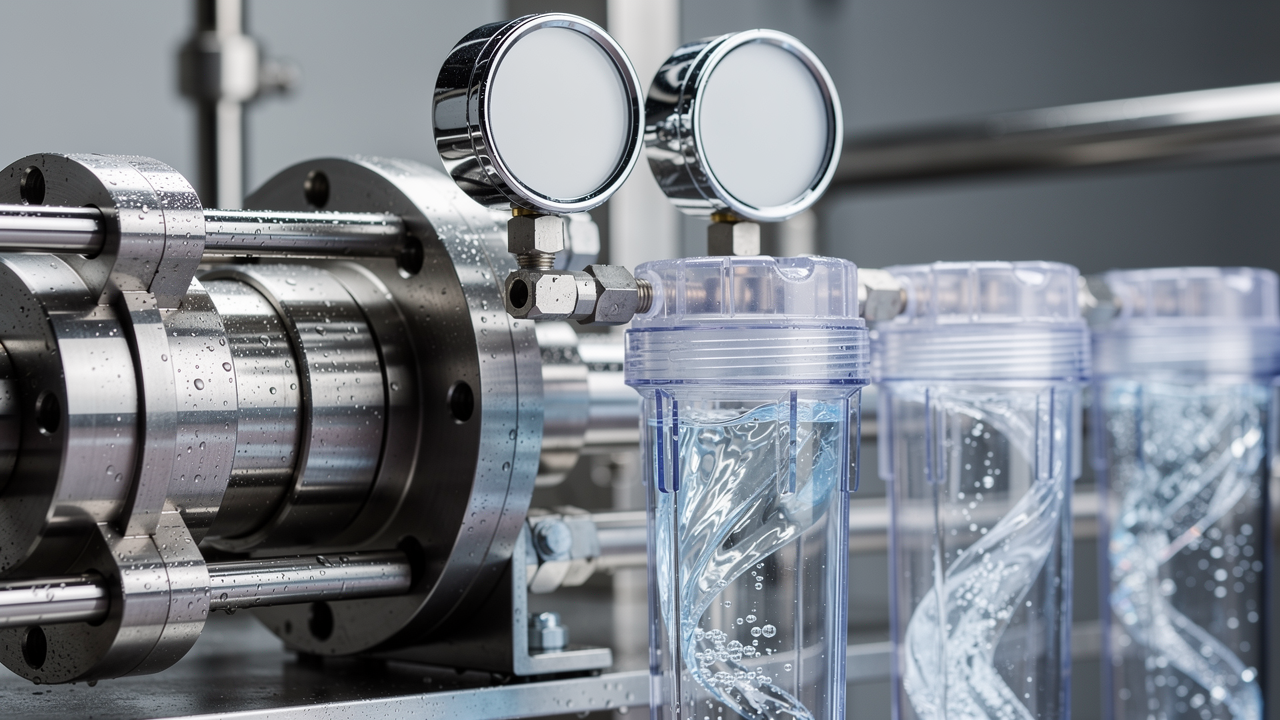
Total cost of ownership for commercial reverse osmosis systems includes far more than the invoice for the skid itself. Structural material, powder-coated steel versus 316 stainless steel, affects both purchase price and corrosion-related service life. Energy consumption, prefilter consumables, chemical dosing reagents, membrane replacement intervals, and wastewater sewer charges for the concentrate stream all stack onto the base price over the equipment's working life. Low-pressure membranes that need less feed pressure to hit target flux reduce the load on the high-pressure pump motor, which shows up directly on the monthly power bill.
| Criteria | Basic Utility Skid | Standard Commercial Package | High-Purity / Redundant Build |
|---|---|---|---|
| Feed Water Compatibility | Limited | Broad | Broad, engineered |
| Pretreatment Integration | Minimal filtration | Complete train | Multi-stage, redundant |
| Instrumentation & Automation | Manual controls, basic gauges | Digital controllers, auto-flush | Full PLC, remote telemetry |
| Recovery Efficiency | ~50% | 60-70% | 75%+ |
| Maintenance Overhead | Higher | Balanced | Minimal |
| Upfront Cost | Lowest | Moderate | Highest |
| Downtime Risk | Higher | Low | Lowest |
Choosing the lowest upfront tier without matching pretreatment almost always costs more within a few years through premature membrane replacement and unplanned downtime. Frequent procurement mistakes include testing water quality once in a mild season and assuming it holds year-round, ignoring pressure drops from building plumbing, undersizing the storage tank, and overlooking local drain capacity limits for the concentrate stream.
How often should membranes be replaced in a commercial RO system?
Typical service life runs three to seven years depending on feed water quality, pretreatment effectiveness, and how closely recovery rate limits are respected. Sites with aggressive scaling or biofouling risk see shorter intervals regardless of membrane brand.
Can a business reuse an oversized RO skid from another facility?
Sometimes, but only after the feed water chemistry, pressure requirements, and control package are re-evaluated against the new site. A skid sized for one water profile can underperform or foul quickly on a different source.
Is a water softener always required before reverse osmosis?
Not always. Antiscalant dosing can replace a softener in many commercial setups, particularly where flow rates are high or space for a salt-based system is limited.
What causes sudden conductivity spikes in permeate water?
A sudden spike usually points to a membrane seal failure, an O-ring leak, or a cracked membrane housing rather than gradual fouling, since fouling tends to raise conductivity slowly over weeks rather than instantly.
About the Business
AQUAPHOR Professional is a manufacturer of advanced commercial and industrial water purification equipment, engineering treatment solutions for sectors ranging from industrial and agricultural operations to HoReCa, healthcare, and municipal supply. Its lineup of reverse osmosis systems is built around custom system design, pairing membrane technology with pretreatment and automation suited to each site's water chemistry and volume requirements.